
In a world of “optimized” meditation streaks, five-step paths to awakening, and spiritual gurus with sleek personal brands, Sri Ramakrishna feels like a beautiful, chaotic glitch in the system. While we treat spiritual enlightenment like a destination we need to reach—or a trophy to display—Thakur (as he was affectionately called) treated it like a game of hide-and-seek with a Mother who was already in the room. He didn’t ask us to be perfect, or even particularly “holy”; he simply asked us to be real. He took the terrifying, abstract concept of “The Infinite” and folded it into the shape of a daily hug, proving that the secret to the universe isn’t found in a complex algorithm, but in the raw, messy, and deeply human capacity to love.
As we navigate the noise of 2026, meeting Ramakrishna isn’t about looking back at history—it’s about looking into a mirror that has finally been wiped clean. The Love Story of the Stone and the Soul
We often hear about his visions of the Mother, Kali. But we rarely talk about the loneliness of his search. Ramakrishna didn’t just “get” enlightenment; he bled for it.
He would stand by the Ganges as the sun set, crying out, “Mother, another day has passed and I haven’t seen You!” He would rub his face against the rough sand of the riverbank until his skin was raw. There is something deeply “touchy” and human about this desperation. It’s the feeling of a child lost in a supermarket, looking for a parent.
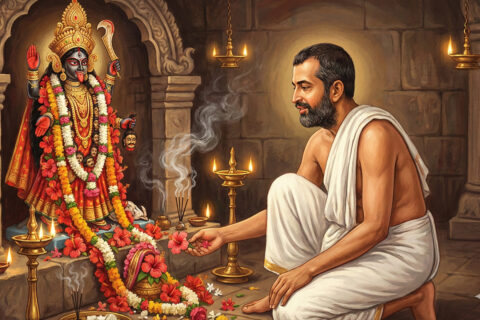
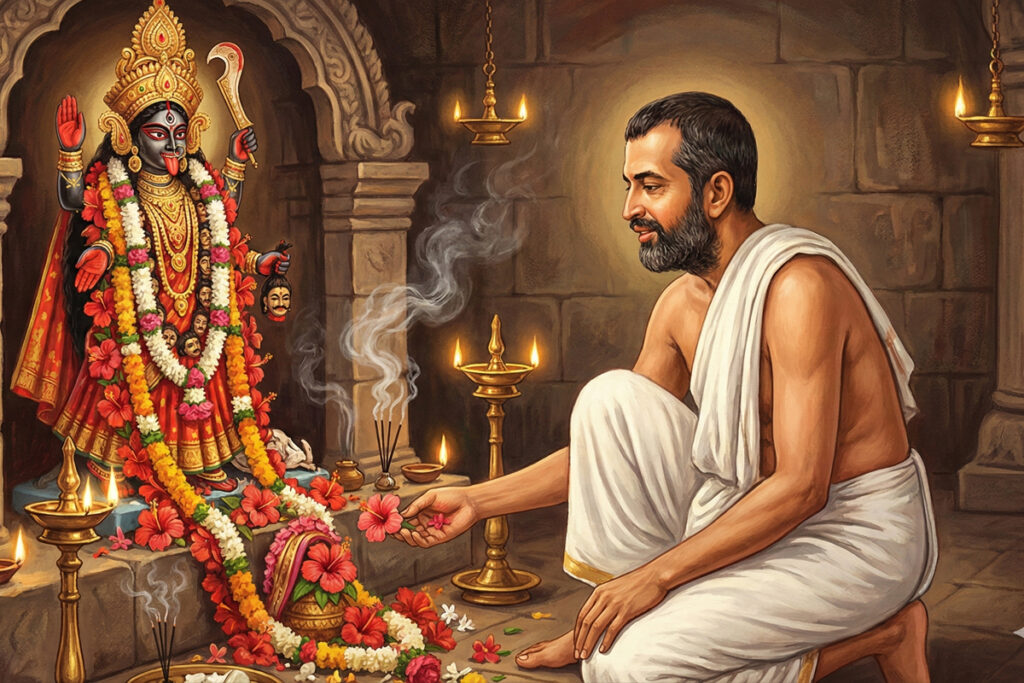
And then, the breakthrough. He didn’t find a “Goddess” in the sense of a remote deity. He found a Presence. He began to talk to the stone idol as if She were sitting right there, breathing. He would offer her a flower, then take it back and put it on his own head, whispering, “You are in me, and I am in You. What’s the difference?”
The Innovation in his Teaching: He broke the “fourth wall” of religion. He showed us that the Divine isn’t looking for your perfect Sanskrit pronunciation; the Divine is looking for your ache. He turned prayer from a formal petition into a messy, tearful, laughing conversation. The Hidden Teaching: We often think spirituality requires a yoga mat and a mantra. Ramakrishna taught us that Awe is the first door to God. If you’ve ever felt your breath catch at a sunset, or felt a lump in your throat hearing a child laugh, you’ve stood where Gadadhar stood. That “glitch” in your routine is the Divine trying to say hello. When he moved to the Kali temple at Dakshineswar, people thought he had lost his mind. He would scream at the stone statue of the Mother, “Are You real? Or am I just talking to a rock?” He would forget to eat. He would rub his face against the ground until it bled, begging for one glimpse of the Living Truth.
This is the “unknown” struggle—the raw, human desperation of a soul that refused to settle for “religion.” He didn’t want a ritual; he wanted a relationship.
Eventually, the “rock” became a Living Mother to him. He would feed her, talk to her, and even argue with her. The Human Touch: He brought God down from the pedestal and put Her in the kitchen. He taught us that Spirituality is intimacy. If you can’t talk to the Divine like you talk to your best friend, you’re just performing theater. The Love Story Nobody Talks About
We cannot talk about the warmth of Ramakrishna without talking about Sarada Devi, his wife. Their relationship is perhaps the most beautiful, misunderstood “spiritual romance” in history.
In a time when women were often relegated to the background, Ramakrishna did something radical. He didn’t “renounce” his wife; he worshipped her. Literally. One night, he seated her on the pedestal of the Goddess and offered flowers at her feet.
They never had a “physical” marriage in the traditional sense, but their intimacy was deeper than any romance. They were two notes of the same chord. She cooked for him, she watched over his health, and she became the “Mother” to all his disciples.
The Lesson of Warmth: Ramakrishna taught us that True Love is the recognition of the Divine in the other. He didn’t see a “wife” or a “woman”; he saw the Creative Power of the Universe in human form. Imagine if we looked at our partners, our friends, or even the stranger on the bus with that same level of sacredness. The world would change in a heartbeat. The “Lustrous” Teaching: Why He Loved Jalebis
One of the most endearing things about Ramakrishna was his humanity. He loved sweets—specifically Jalebis. He loved to sing. He loved to mimic the walk of a “pompous” person to make his disciples laugh.
He was once asked why he, a great saint, still had a craving for sweets. He replied with a wink, “If I don’t keep a small ‘desire’ for something—like a Jalebi or a chat with my boys—my soul will just fly away and leave this body behind.”
This is the Teaching of the “Ripe Ego.” He told his followers: “You don’t have to be perfect. You just have to be ‘ripe’.”
- The Unripe Ego says, “I am the doer, I am the boss, I am better than you.”
- The Ripe Ego says, “I am a child of God. I am a servant of humanity.”
He didn’t ask us to kill our personalities; he asked us to decorate them with devotion. He taught that you can enjoy a good meal, a beautiful song, and a comfortable bed, as long as you remember who provided the “ingredients.” The Great Synthesis: The Laboratory of God
Perhaps the most “innovative” part of Ramakrishna’s life was his period of radical experimentation. He didn’t just “read” about other paths; he lived them.
- He practiced Islam until he saw the Prophet.
- He meditated on Christ until he felt the presence of the Son of Man.
- He practiced the various paths of Hinduism—from the worship of Rama to the most intense Tantric rituals.
His conclusion wasn’t a philosophical theory; it was a realization: “Jato Mat, Tato Path” (As many faiths, so many paths).
In a world currently torn apart by “My God vs. Your God,” Ramakrishna’s voice is the cooling balm we need. He didn’t say all religions are the same “on the surface.” He said they all lead to the same Depth. The End that wasn’t an End
Towards the end of his life, Ramakrishna suffered from throat cancer. It was a period of immense physical pain. He could barely swallow. Yet, his room was always full of laughter.
When his greatest disciple, Naren (who would become Swami Vivekananda), saw him suffering, he was heartbroken. He asked, “Thakur, why don’t you ask the Mother to heal you?”
Ramakrishna looked at him with the tenderness of a thousand mothers and said, “I have given this mind to Her. How can I take it back to ask for something for this lump of flesh?”
Even in his final moments, he wasn’t a “patient”; he was a “Presence.” He showed us that the body is just a shirt we wear, and even when the fabric is torn, the Person wearing it remains untouched.
Why You Should Care Today
You might be reading this and thinking, “This is beautiful, but I have a 9-to-5, a mortgage, and a messy life. I can’t be like him.”
But that’s the secret: Ramakrishna didn’t want you to be like him. He wanted you to be like You, but with the “lights turned on.” His life is a reminder that:
- God is not a hobby: It’s the background music of your life.
- Kindness is the highest scripture: He often said that a person who truly loves God cannot be unkind to a single living soul.
- Simplicity is Power: In an age of “over-complication,” the simplest heart is the strongest.
Ramakrishna was the “God-Drunk Child” who stumbled into the garden of the Infinite and left the gate open for the rest of us. He didn’t leave behind a set of rigid rules; he left behind a Vibe—a frequency of unconditional love, radical acceptance, and child-like joy.
So, the next time you feel overwhelmed by the world, remember the man from Dakshineswar. Close your eyes, breathe, and imagine him sitting there, smiling, offering you a Jalebi, and reminding you that you are already “The Mother’s Child.”
The ocean is deep, but you don’t have to be afraid. Just jump in. The water is warm.While we treat spiritual enlightenment like a destination we need to reach—or a trophy to display—Thakur (as he was affectionately called) treated it like a game of hide-and-seek with a Mother who was already in the room. He didn’t ask us to be perfect, or even particularly “holy”; he simply asked us to be real. He took the terrifying, abstract concept of “The Infinite” and folded it into the shape of a daily hug, proving that the secret to the universe isn’t found in a complex algorithm, but in the raw, messy, and deeply human capacity to love.
As we navigate the noise of 2026, meeting Ramakrishna isn’t about looking back at history—it’s about looking into a mirror that has finally been wiped clean.
“Jai Thaku, Jai Ma, Jai Swamiji”