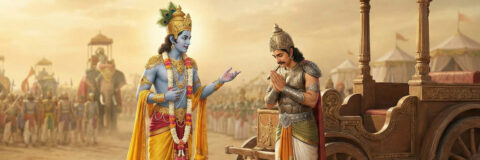

The conch shells faded, leaving a heavy silence. Between the two armies—the Pandavas and the Kauravas—lay a battered stretch of earth, still slick with morning dew. Soldiers packed the field, shimmering in their armor as the first sunlight hit them, a thousand fiery flashes across the lines. The air pressed in, thick with the harsh tang of metal and the animal heat of elephants. Somewhere, a peacock called out. Krishna’s bird, people would say later, as if even nature knew what was about to unfold. Right in the heart of this vast scene, a white chariot stood still. Arjuna, the archer everyone talked about, slumped forward, his legendary Gandiva bow slipping from his shaking hands. Tears traced clean lines through the dust on his face. He stared out at his grandfather Bhishma, his teacher Drona, his cousins and kin—all lined up for war, ready to kill or be killed. “I can’t do this,” Arjuna choked out, his voice crumbling. “What kind of victory is worth this blood? What kingdom could possibly be worth losing everyone I love?” He trembled, grief pouring out of him, raw and bottomless. This was Arjuna—Partha the mighty—paralyzed for the first time, not by fear, but by a storm inside that threatened to tear him apart. His skin had gone pale, his mouth was dry, his whole body tight and unsteady.
Later, scholars would call this *vishada*—a sacred despair that comes before awakening. Krishna stood at the front, holding the reins, and turned to face him. You could feel it, that moment—the world itself seemed to shift. People who saw it, and the sages who spent years thinking about it afterward, all said something changed in Krishna’s eyes. The friend, the joker, the beloved companion—he faded. Something ancient and endless looked out instead. His eyes, warm just a second before, suddenly burned with the weight of a thousand suns. This is the moment you don’t hear much about in the usual stories—when Krishna stopped being just a friend and became a *guru*.
The Bhagavata tradition says that, right then, Krishna called up the full awareness of Vishnu, the preserver, the eternal witness. Even his voice changed. When he spoke, it felt like the air itself vibrated, like the world was listening. “Arjuna,” Krishna said. Just his name—spoken that way—was a lesson. “Where did this weakness come from, right now, when everything matters? This isn’t worthy of you. It leads nowhere but disgrace.” But Arjuna was lost in that storm. “How can I fight people I should honor? Better to beg than kill these great souls. If I win by killing them, the victory itself will feel poisoned.” What happened next?
Vedic scholars, doing the math from the Mahabharata’s astronomy, say it took about forty-five minutes. That’s all—just three quarters of an hour to pour out the philosophy of existence, to distill it, to hand it over in words that would echo for thousands of years. Krishna’s answer hit like lightning wrapped in silk. “You grieve for those who shouldn’t be grieved for, but you speak as if you’re wise. The wise don’t mourn for the living or the dead.” He stepped closer, voice softer now, but unbreakable. “There was never a time when I didn’t exist, nor you, nor these kings. And there never will be a time when we cease to exist. Just as the soul passes through childhood, youth, and old age in this body, it moves on to another.
The wise aren’t fooled by this.” This was the first big lesson—*viveka*, clear seeing. Knowing what’s real, what’s passing. Krishna wasn’t just comforting a broken man. He was peeling back the layers of Arjuna’s mind. “The soul, Arjuna, can’t be cut by weapons or burned by fire. Water can’t dampen it. Wind can’t dry it. It’s always there, unchanging, unshakable, ancient.” As Krishna spoke, it was as if the battlefield itself changed. The old texts say there’s more going on here—Kurukshetra, the “field of dharma,” isn’t just a place. It’s the field inside each of us—the body, the mind—the ground where wisdom and ignorance fight every day. The Kauravas stood for the hundred faces of the ego: anger, greed, pride, envy, and all their endless variations. The Pandavas, just five, were the higher powers: clear seeing, devotion, discipline, detachment, and determination.