
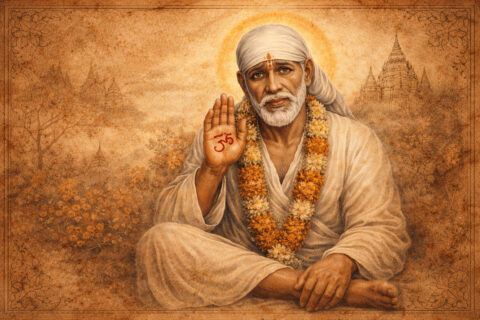

Writing about Shirdi Sai Baba isn’t your typical biography project. It’s more like trying to explain the wind. You can’t really say where it begins, but you definitely feel it everywhere. For over a hundred years, the little village of Shirdi in Maharashtra has been the heart of a quiet spiritual revolution. No armies, no manifestos—just a humble fakir, a fire that never goes out, and a bottomless well of compassion.
Let’s take a closer look at Sai Baba’s life, his miracles, and why his presence still feels so real today. To make sense of the miracles, you have to look at the person behind them. Sai Baba showed up in Shirdi as a teenager, quietly sitting under a neem tree. No name, no background, no family to speak of. He didn’t carry any holy books, but it seemed like he knew all of them anyway.
He moved into a broken-down mosque he called Dwarkamai, and that’s where he stayed. In a world obsessed with labels—Hindu, Muslim, rich, poor—Sai Baba just broke all the rules. He lived like he had nothing, but he gave like he had everything. His robe was torn, but he held the secret to people’s peace of mind.
1. The Miracle of the Water-Lit Lamps
One of the first miracles people talk about is the story of the lamps. Every evening, Sai Baba liked to light little clay lamps in the mosque. He’d go around asking the local shopkeepers for a bit of oil.
One day, the shopkeepers decided to mess with him. They told him there was no oil. They figured he’d just have to sit in the dark. Instead, Sai Baba took a tin of water back to the mosque, poured it into the lamps, and lit them. To everyone’s shock, the lamps burned bright all night.
This wasn’t some party trick. It was a lesson: when you run out of your own “oil,” faith can keep your light going.
2. The Alchemy of Udi: Healing in the Ashes
If you visit Shirdi, you’ll see people carrying little packets of gray ash called Udi. It comes from the Dhuni—the fire Sai Baba lit more than a century ago, still burning today.
Sai Baba used this ash to heal everything from the plague to a stomach ache. But the real miracle wasn’t just physical healing. Udi is a reminder: everything, including our bodies, eventually turns to ash.
When he gave Udi, he wasn’t just easing pain—he was reminding people to focus on what lasts. It was comfort for the body and food for the soul.
3. The Master of Time and Space
There are loads of stories in the Sri Sai Satcharitra about Sai Baba showing up for people who were nowhere near Shirdi.
One story goes like this: a devotee’s daughter in a distant city fell into a furnace. At the exact same time, Sai Baba reached his own arm into the fire in Shirdi. He got burned, but far away, the girl felt herself pulled to safety.
People asked him why he did it. He just said, “The child fell in. I had to save her.” For him, distance didn’t matter. Every devotee was right there with him, no matter where they were.
4. The Bridge of Communal Harmony
Back in Sai Baba’s time, religious tensions ran high. But his life was proof that unity is possible. He lived in a mosque, but let Hindus perform their rituals there. He quoted the Quran and the Vedas, often in the same breath.
His most famous words—“Sabka Malik Ek” (“Everyone’s Master is One”)—weren’t just a slogan. He lived them. He pushed people to look past the surface and see the soul underneath. In a world that still feels divided, that message matters now more than ever.
5. Shraddha and Saburi: The Two Pillars
Ask a Sai devotee about his core teaching, and two words come up: Shraddha (Faith) and Saburi (Patience). Sai Baba said he gave his followers two coins—these two virtues. Shraddha is steady belief that he’s here. Saburi is the quiet strength to wait for storms to pass. The real miracle isn’t that he makes life easy. It’s that he makes you strong enough to face whatever comes. He never promised a life without problems. He promised to walk through the fire with you.
6.The Living Presence: Why Shirdi Still Matters
People often wonder, “How can a man who died in 1918 still perform miracles?” The answer is simple: Sai Baba promised to stay with his devotees, even from his tomb. And even now, people share stories—a stranger calls at just the right time, a dream brings an answer when it’s needed most. For so many, it still feels like he’s right there, walking alongside them. Sometimes, it’s just a question that pops into your mind, or a sudden wave of calm right in the middle of a panic attack. These aren’t the kind of miracles that make headlines. They’re quieter—miracles of the heart. But honestly, those are the ones that keep people moving forward.
7.Why do we feel drawn to him?
Sai Baba connects with us because he seems so real. He got angry now and then. He laughed, cooked giant pots of food for anyone who needed it, and loved his followers with the fierce protectiveness of a mother. He wasn’t some distant figure up in the sky. He was that old man in the corner of the mosque who genuinely cared if you’d had a proper meal.
8.One last thought
The biggest miracle of Shirdi Sai Ram isn’t turning water into oil lamps or curing sickness. The real miracle is how he changes people from the inside out. He takes someone tangled up in stress, greed, or confusion and, bit by bit, works through the heat and messiness of life to help them find real peace—right now, in this moment. So whether you’ve believed in him your whole life or you’re just curious about the man in the white headscarf, his message is simple: “Give me your worries. I’ll carry them for you.”